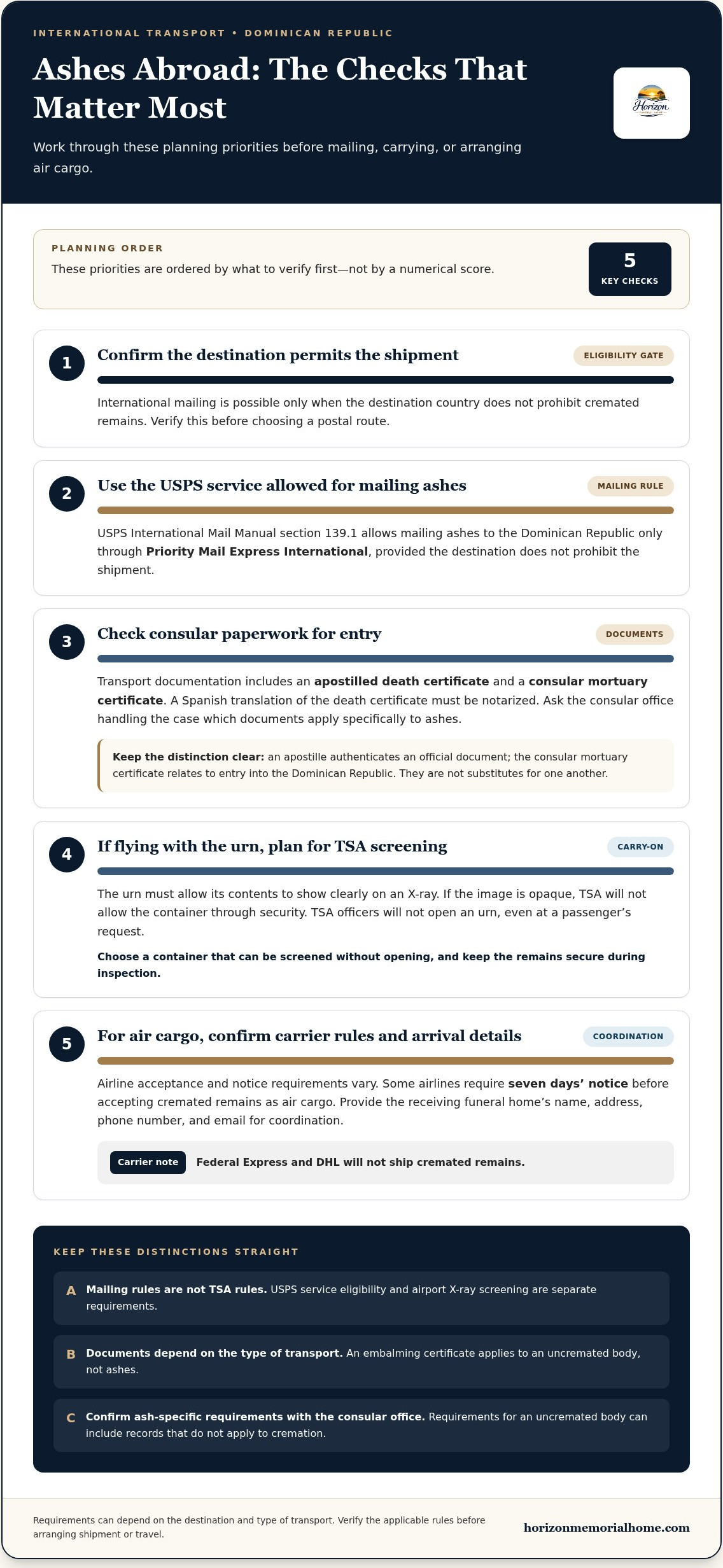

Mailing ashes internationally is possible, but only when the destination country permits it and postal rules are followed. According to USPS, International Mail Manual section 139.1 allows sending ashes to the Dominican Republic by mail only through Priority Mail Express International, provided the destination doesn’t prohibit the shipment.
That rule gives you a starting point, but it doesn’t answer every practical question. You may be deciding whether to mail the ashes or carry them on a flight while trying to honor your loved one and avoid delays. The details can feel like a lot to manage at once.
This guide explains mailing conditions, what to consider when traveling with ashes, and which documents or requirements may apply through the Dominican consulate, your destination, and the funeral director coordinating arrangements. It also explains how a funeral director can help organize paperwork and transportation. The goal is to make the next steps clearer, so you can plan with care and focus on bringing your loved one home.
Key Takeaways
- International mailing may be an option when the destination permits cremated remains and the shipment meets USPS service and packaging rules.
- Before choosing air travel, learn how TSA screening affects urns and why a container’s materials can matter at security.
- Consular paperwork for transporting remains can include official certificates, permits, and Spanish translations; requirements depend on the type of transport.
- Coordinate the receiving funeral home’s details and transport documents early to help the journey proceed smoothly.
- A licensed funeral director can help organize the paperwork and logistics when you need support bringing your loved one to the Dominican Republic.
Table of Contents
- Consulate and embassy requirements for international transport
- International mailing eligibility for cremated remains
- Carry-on or checked baggage?
- International transport and destination-country requirements
- Licensed funeral director assistance
- Horizon Funeral Home: Traditional Funeral Services
Consulate and embassy requirements for international transport
Consular paperwork depends on whether you’re transporting cremated remains or an uncremated body. If you’re sending ashes to the Dominican Republic, identify the required documents before arranging travel or shipment.
Apostilles and Consular Mortuary Certificates
An apostille authenticates the seal and signature on an official document for use in another country. The Dominican consulate must issue a consular mortuary certificate for human remains entering the Dominican Republic. These documents serve different purposes: an apostille authenticates a document, while the consular certificate relates to entry. Match each requirement to the document it applies to, and don’t treat one as a substitute for the other.
Death Certificates and Consular Documentation
Local authorities typically issue the death certificate where the death occurred. For international transport of human remains, the required documents include an apostilled death certificate, an embalming certificate, and a transit permit. The death certificate’s Spanish translation must be notarized, and transport documents must be in Spanish and notarized by a Dominican notary. The consulate may require translations of other documents, too.
For cremated remains, ask the consular office handling the case which documents apply to ashes. Requirements for an uncremated body can include records that don’t apply to cremation, such as an embalming certificate. Keep the original death certificate and any apostille with the Spanish translation so the consular file can be reviewed as a set.
Identity Documents for Consular Steps
Consular identity verification may use the deceased’s active or canceled passport, or a birth certificate. Choose an available document that clearly identifies the person named on the death certificate. Check that names match across records, including differences in spelling or name order. Consistent details help connect the identity document to the death record and transport paperwork.
For an uncremated body, the documentation process also includes a transit permit authorizing the remains to leave the United States. A licensed embalmer must issue the embalming certificate, which must meet Dominican requirements. These records cover distinct steps: the death certificate documents the death, the embalming certificate records preparation, and the transit permit authorizes departure.
If you are handling the consular process from the New York metropolitan area for families working with Horizon Funeral Home, you will coordinate with the Consulate General of the Dominican Republic in New York, located at 1501 Broadway, Suite 410, New York, NY 10036. Its listed telephone number is 212-768-2480. Keep the consulate’s location and phone number with your document checklist, especially when coordinating originals and notarized Spanish translations.
Before submitting a file, arrange the records in a clear sequence: death certificate, apostille, required Spanish translation, identity document, and other applicable transport certificates. For example, a file for an uncremated body includes the embalming certificate and transit permit. A consular mortuary certificate is also required for human remains entering the Dominican Republic. An organized file helps you track each document through consular review.
International mailing eligibility for cremated remains
According to USPS, international mailing is allowed only when the destination country doesn’t prohibit cremated remains and the shipment uses Priority Mail Express International. For travel from the United States to the Dominican Republic, prepare the death certificate and consular paperwork, including an apostille and consular mortuary certificate.
TSA Rules for Carrying Cremated Remains
TSA screens cremated remains like other carry-on items, but the urn must let its contents show clearly on an X-ray. If the image is opaque, TSA won’t allow the container through security. TSA officers also won’t open an urn, even if a passenger asks. Choose a container that can be screened without opening, and keep the remains secure during inspection.
These rules concern air travel, not USPS mailing eligibility. A funeral home can help coordinate transportation and documentation, but TSA’s screening decision depends on whether the container’s X-ray image is clear.
Travel Documents for Cremated Remains
For entry into the Dominican Republic, the consular documentation includes a consular mortuary certificate and an apostilled death certificate. International transport documentation also lists a notarized Spanish translation of the death certificate. The certificate generally identifies the deceased by full name, date and place of death, and cause of death. Keep these records together for consular review.
The embalming certificate applies to transport of an uncremated body, not ashes. For cremated remains, use documents that identify the deceased and show consular authorization for entry. This paperwork is separate from the urn and airline arrangements.
Air Shipment of Cremated Remains
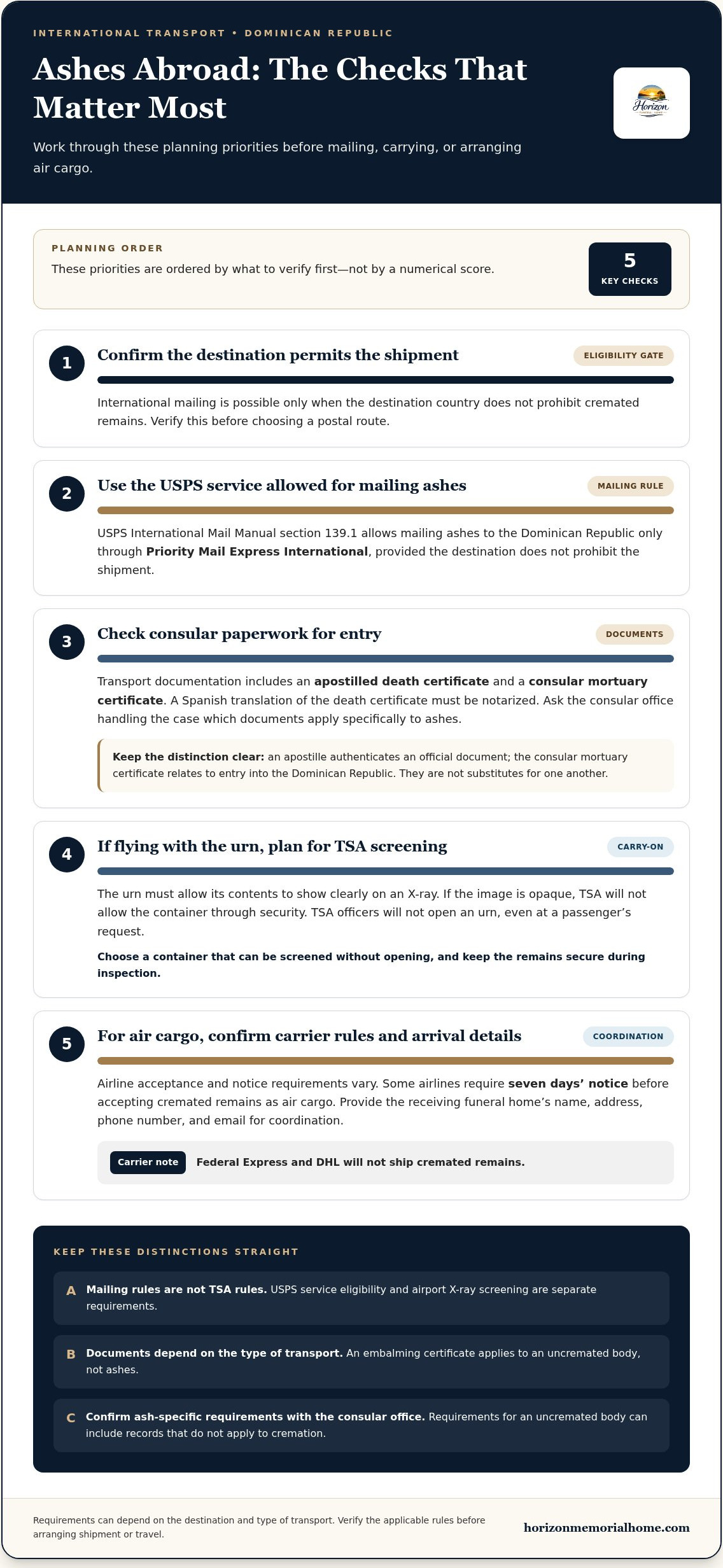
Air shipment can be arranged as cargo, but airline acceptance and notice requirements vary. Some airlines require seven days’ notice before accepting cremated remains as air cargo. Include the receiving funeral home’s name, address, phone number, and email in the coordination details so the destination team can prepare for arrival.
USPS isn’t the only consideration: Federal Express and DHL won’t ship cremated remains. A consular mortuary certificate can accompany cremated remains shipped to the United States as air freight on a commercial flight, but that applies to entry into the United States, not cargo bound for the Dominican Republic.
For USPS mail, International Mail Manual section 139.2 requires a sealed, siftproof funeral urn inside a strong, durable outer container. Add enough cushioning to prevent the urn from shifting, and make the outer container siftproof. Section 139.3 requires the mailer to identify the contents on the applicable customs declaration form.
Since March 1, 2025, USPS requires its Cremated Remains shipping supplies for mailing human or animal remains, domestically or internationally. USPS also limits additional services to additional insurance and return receipt. These packaging rules apply only if the Dominican Republic permits the shipment; mailing eligibility and consular entry paperwork are separate steps.
Carry-on or checked baggage?
For cremated remains, carrying the urn in the cabin avoids the risks of checked baggage. Checked luggage can be lost, delayed, or damaged, so coordinate the flight and handoff with the receiving funeral home.
Before booking airfare, decide whether you’ll travel with the urn or arrange air cargo. These require separate arrangements: a passenger ticket covers your travel, while cargo needs its own airline booking and shipment coordination. The airline’s acceptance process and the destination’s customs requirements both shape the plan.
Carry-on and Checked Baggage
Carry-on baggage keeps the urn with you during the journey rather than in the aircraft hold. TSA screening is a key consideration: the container must produce an X-ray image that isn’t opaque. TSA won’t open a container of cremated remains, even at a passenger’s request. Choose an urn that can be screened intact and pack it securely for security screening.
Checked baggage carries a different risk. A bag can be delayed, damaged, or lost, separating the remains from you during travel. When comparing the options, consider whether the urn can pass through TSA screening and whether keeping it with you fits your arrival arrangements.
Airline Policies and Coordination
Airlines set their own procedures for accepting cremated remains as cabin baggage or cargo. Contact the airline handling each flight segment and follow its instructions for the urn, required documents, and check-in. If your itinerary includes connections, account for each airline involved, not just the first carrier.
For air cargo, some airlines require seven days’ notice before accepting cremated remains. Start coordinating early enough to book the cargo, prepare the required paperwork, and align arrival with the receiving funeral home. Cargo arrangements follow a different process from passenger cabin baggage.
Arrival and Funeral Home Handoff
Give the receiving funeral home’s name, address, phone number, and email to those coordinating transportation. These details help the airline and destination contacts identify who will receive the shipment. Share the expected arrival information with the funeral home so it can plan the handoff.
Keep your travel documents and consular paperwork together, with copies carried separately from the urn. That way, an airline or customs officer can review the records without opening the container. Consular paperwork supports entry, while the airline’s procedures govern the journey itself.
Choose one person to coordinate airline updates, documents, and the receiving funeral home’s details. For example, that person can match the flight itinerary to the cargo arrival and pass airline changes on to the destination contact. A clear handoff plan helps keep each part of the journey connected.
International transport and destination-country requirements
For mailed ashes, USPS International Mail Manual section 139.3 requires the sender to identify the contents on the customs declaration; Dominican entry also requires a consular mortuary certificate. Delays or refusal can result from incomplete documents, missing consular approval, destination-country restrictions, or flight availability. For burial or scattering permission, contact the receiving funeral home and the local authority responsible for the intended location.
International Remains Transportation Services
International transportation connects departure arrangements, the airline or postal carrier, the consulate, and the receiving funeral home. For the Dominican Republic, provide the receiving funeral home’s name, address, phone number, and email so there’s a clear destination contact. Keep the itinerary and document copies together. Each handoff depends on matching shipment details with the person receiving the remains.
Allow at least two weeks for international transport of cremated remains. Repatriation between the Dominican Republic and the United States can often be completed in approximately 7 working days, depending on documentation and flight availability. These timelines describe different guidance, so build the plan around the paperwork and route involved.
Postal Rules for Sending Ashes
USPS International Mail Manual section 139.1 allows international mailing only when the destination country doesn’t prohibit cremated remains and the shipment uses Priority Mail Express International. The Dominican Republic’s acceptance is therefore central to choosing mail. A postal service’s ability to carry a package doesn’t replace destination-country permission or consular documentation.
Section 139.3 requires the sender to identify the contents on the applicable customs declaration form. Complete that declaration accurately and keep it consistent with the shipment records. USPS also requires its Cremated Remains shipping supplies for international mailing, effective March 1, 2025. The customs form and required supplies address postal handling, not consular approval.
International Transport Legal Requirements
International transport requirements combine carrier rules with the destination country’s entry requirements. For the Dominican Republic, a consular mortuary certificate is required for human remains to enter. An apostilled death certificate and notarized Spanish translation are also listed in the documentation. Keep these records available for consular review and arrival.
International rules for transporting human remains are identified by the International Air Transport Association and the World Health Organization. A shipment can be delayed if documents are incomplete, translations are missing, the consulate hasn’t approved transport, or a flight changes. A destination-country prohibition can prevent mailing even when the package meets postal requirements.
Customs Declarations and Import Procedures
For a USPS shipment, declare the contents on the customs form as required by section 139.3. Keep the declaration aligned with the shipment and supporting records, including the consular mortuary certificate required for entry into the Dominican Republic. Customs paperwork and consular documentation serve separate purposes, so include both in the transport plan.
For burial or scattering, the receiving funeral home can help identify the local authority responsible for permission at the intended destination. Share the arrival details and ask which local process applies there. This step is separate from customs clearance and consular approval, and connects arrival planning with the family’s intended arrangements.
Licensed funeral director assistance
A licensed funeral director can help organize international transport across documents, carriers, and destination contacts. Coordination is key: the deceased’s records, consular file, and travel plan must refer to the same person and destination. Start by identifying who is authorized to make arrangements and who will receive the remains in the Dominican Republic.
If the next of kin asks someone else to handle arrangements, document that authorization. The next of kin must sign a release authorizing the other person to act on their behalf. Give the signed release to the person coordinating arrangements so they can proceed with clear authority.
A funeral director can help organize documents and track which step each one supports. For an uncremated body, the file can involve a death certificate, embalming certificate, and transit permit. For cremated remains, the relevant consular and destination requirements differ. Keeping these two document pathways separate helps prevent families from preparing paperwork for the wrong type of transport.
Use a simple document-control process:
- Match the deceased’s name across the death certificate, identity record, and transport paperwork.
- Keep originals, apostilles, and Spanish translations grouped by document.
- Record which papers are for consular review, airline handling, or postal customs declarations.
- Share the receiving funeral home’s name, address, phone number, and email with the coordinator.
For example, if a Spanish translation is notarized but the apostille belongs to a different document, the file may need reorganizing before review. A coordinator can maintain a document checklist and flag mismatched names or missing signatures before shipment arrangements are made. This can be especially useful when relatives share responsibility from different places in the United States.
Timing also depends on the transport method. International transport guidance recommends allowing at least two weeks for cremated remains. A funeral director can align the paperwork sequence with the proposed flight or mailing route and keep the receiving contact informed about changes. Airline cargo and passenger travel have separate procedures, so specify which route the family is using.
Ask the person coordinating arrangements to explain the next document step, who is responsible for it, and how the receiving funeral home will be notified. That practical handoff helps families understand where a permit, consular approval, or travel document fits. To discuss support with international funeral arrangements, connect with a funeral coordinator.
Horizon Funeral Home: Traditional Funeral Services
Horizon Funeral Home can help families coordinate funeral arrangements when international transport, cremation, or a traditional service is part of their plans. Its Worldwide Transportation offering supports arrangements involving a loved one’s journey across borders, while Traditional Funeral Services and Cremation provide options for honoring them. Veteran Honors are also available for eligible service members.
If you’re weighing how to bring your loved one to the Dominican Republic and plan a meaningful farewell, Horizon Funeral Home can help you understand the next steps. The right arrangements depend on your family’s wishes and the transport pathway you choose.
Contact Horizon Funeral Home or visit horizonmemorialhome.com to discuss your arrangements.
Take the Next Step at Your Own Pace
Choosing how to bring a loved one home is both a practical decision and a deeply personal one. As you consider sending ashes to the Dominican Republic, focus on the arrangement that reflects your family’s wishes, then give yourself space to organize the next step with care.
Horizon Funeral Home offers Traditional Funeral Services, Cremation, and Worldwide Transportation. These services can support families planning a farewell involving cremation, international travel, or a traditional service. A conversation can help you discuss the personalized support that fits your plans and what you’d like to do next.
Contact Horizon Funeral Home for assistance as you plan your arrangements. You can take this one decision at a time, with your loved one’s wishes and your family’s needs at the center.
Frequently Asked Questions
Can I post ashes internationally?
Yes, USPS allows international mailing of cremated remains when the destination country doesn’t prohibit them and the shipment uses Priority Mail Express International. USPS International Mail Manual section 139.1 sets out that condition. The destination’s rules matter as much as postal eligibility, so postal acceptance alone doesn’t establish permission to enter another country. The customs declaration must also identify the shipment’s contents.
Can you legally bring or ship cremated ashes to the Dominican Republic?
Cremated remains can be transported when the route and Dominican entry requirements are met. A consular mortuary certificate is required for human remains entering the Dominican Republic, and mailing also depends on the destination country’s acceptance. For air travel, TSA screening rules concern security, not Dominican import permission. Treat carrier procedures and consular entry documents as separate parts of the journey.
Does the Dominican Republic require an apostille or Spanish translation for cremation documents?
The documentation guidance lists an apostilled death certificate and a notarized Spanish translation of that certificate for international transport to the Dominican Republic. An apostille authenticates an official document’s seal and signature for use abroad. The consular mortuary certificate is a separate document. Keep the original death certificate, apostille, translation, and consular certificate together so each record can be matched during review.
What are the TSA and airline rules for carrying cremated ashes in a container?
TSA won’t allow a container of cremated remains through security if its X-ray image is opaque, and officers won’t open it. Choose an urn that can be screened intact. TSA screening doesn’t replace the airline’s baggage rules: airlines set their own acceptance procedures for cabin baggage and cargo. Carrying the urn in the cabin avoids the risks of checked luggage being delayed, lost, or damaged.
Can cremated ashes be sent by mail or courier from the United States to the Dominican Republic?
USPS permits international mailing through Priority Mail Express International only when the destination country doesn’t prohibit cremated remains. Since March 1, 2025, USPS requires its Cremated Remains shipping supplies for these mailings. The package must meet postal packaging requirements and its contents must be declared. Federal Express and DHL will not ship cremated remains, so courier services aren’t interchangeable with USPS.
Which airlines fly ashes to the Dominican Republic and what are their requirements?
Airline acceptance and requirements vary, so there isn’t one universal carrier procedure for this route. Some airlines require seven days’ notice before accepting cremated remains as air cargo. Cargo bookings are separate from passenger baggage arrangements, and the receiving funeral home’s details help coordinate arrival. Don’t assume a specific airline from general transport rules: requirements depend on the flight and shipment method.
How much does it cost to transport cremated remains to the Dominican Republic?
Horizon Funeral Home provides cost information after learning what your family needs. Costs vary based on services, merchandise, transportation, disposition, and outside providers selected. Airline, consular, and receiving-funeral-home charges may be separate from Horizon’s fees. Horizon coordinates Worldwide Transportation for families in Brooklyn, Queens, Staten Island, Manhattan, the Bronx, and Nassau County, with care in English, Russian, Armenian, Georgian, and Spanish.
What are the steps for transporting ashes to the Dominican Republic in checked baggage or carry-on?
First, choose a container TSA can screen without opening. Next, plan the itinerary and keep the death certificate and consular documents accessible. Then follow the airline’s baggage process for each flight segment. Carry-on travel keeps the urn with you; checked baggage can be delayed, lost, or damaged. On arrival, coordinate the handoff with the receiving funeral home using its contact details.